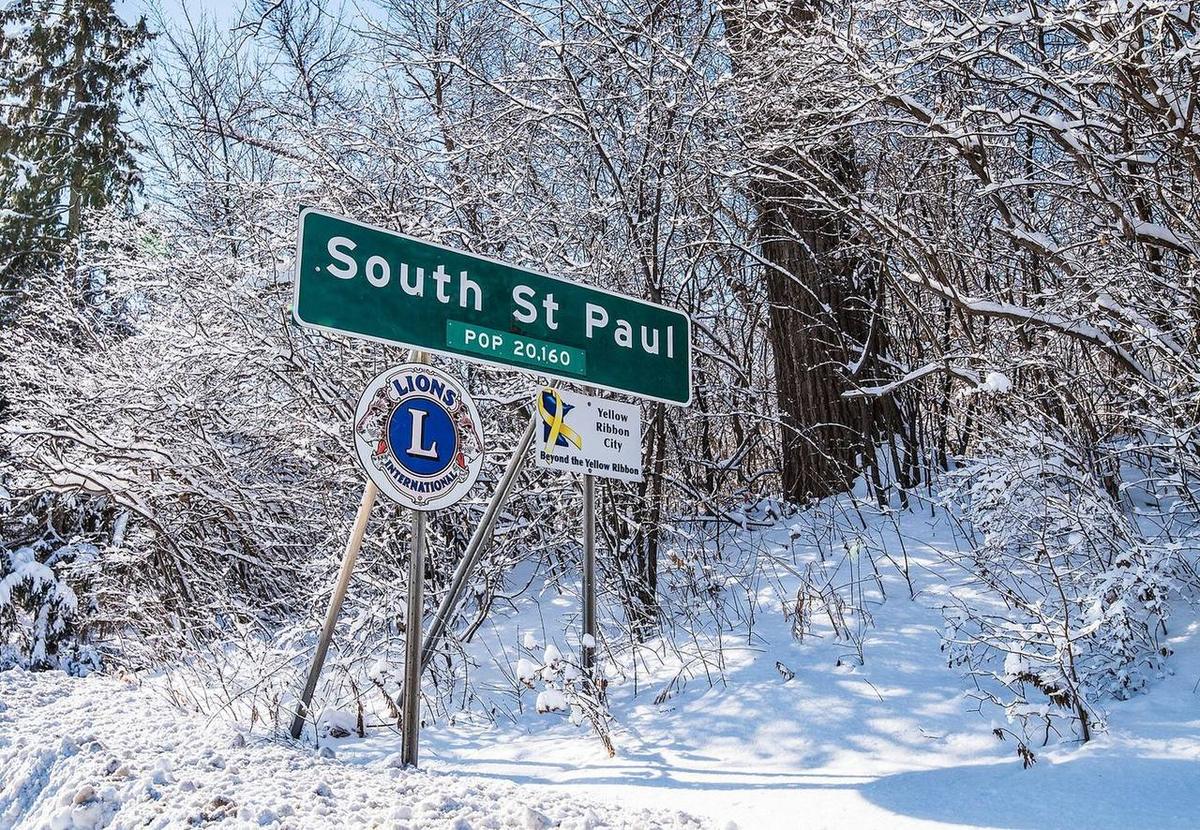
01 Priority one is the hill
The city plows all publicly owned streets and alleys, typically at 2 inches or more. Under 2 inches, it treats hills and main streets.
There are no designated emergency snow routes. Priority 1 is still main streets and hills — because this is a river-bluff town, not a flat grid. Local streets follow. Alleys and trails follow that. Sidewalks, steps, and parks as needed. Six plow zones cover the map. The snow removal page is the city’s own sequence.
§58-101(a) says a vehicle may not sit on a street or alley so as to obstruct plowing. Move it before crews start. After the first curb-to-curb pass, police may tag leftover cars and tow the next morning.
02 Riverfront and bluffs
South St. Paul sits in Dakota County immediately south and southeast of Saint Paul, on the Mississippi, east of West St. Paul. Census 2020: 20,759 people, 5.63 square miles of land, density 3,690.5. Wikipedia: elevation 719 feet; historic major meat-packing industrial riverfront. Older neighborhoods climb the bluffs above that corridor.
The sidewalk clock is short. §54-4 treats snow, dirt, or rubbish left on a public sidewalk more than 12 hours after deposition as a public nuisance. The city may clear it and bill the owner. That is not the driveway, and it is not a commercial lot on the flats.
The Twin Cities climate figure we use is 51.2 inches a year at Minneapolis–St. Paul International Airport (MSP / NCEI station USW00014922), the 1991–2020 NOAA climate normal — the same number the Minnesota DNR State Climatology Office publishes. That is the airport station, not a city-by-city total.
03 What we plow on the bluff
Plow MN is licensed and insured. We plow residential driveways and walkways and commercial lots in South St. Paul, seasonal or per-plow. We do not take the public hills, alleys, or trails. We take the private surface that still has to open while Priority 1 is working the grade.
No designated emergency snow routes. The city still plows all publicly owned streets and alleys, typically at 2 inches or more. Under 2 inches it treats hills and main streets. See the city FAQ.
Priority 1 is main streets and hills. Then local streets. Then alleys and trails. Then sidewalks, steps, and parks as needed. Six plow zones cover the city. A house on a bluff street is in the first cut; an alley behind it is not.
Municipal Code §58-101(a): a vehicle may not be parked on streets or alleys so as to obstruct snow plowing. Vehicles must be removed before plows begin. After the first curb-to-curb pass, police may tag remaining cars (snowbirds) and tow the next morning.
Ordinance §54-4: snow, dirt, or rubbish left on a public sidewalk more than 12 hours after deposition is a public nuisance. The city may clear it and bill the owner. That is a shorter clock than Minneapolis or Saint Paul. The snow removal page and a sidewalk FAQ spell it out.
Census 2020: 20,759 people on 5.63 square miles of land, density 3,690.5. Wikipedia lists elevation 719 feet and a historic meat-packing industrial riverfront. Compact older neighborhoods sit on river bluffs and hills above the floodplain industrial corridor. Hills are Priority 1 for a reason.
The Twin Cities climate figure we use is 51.2 inches a year at Minneapolis–St. Paul International Airport (MSP / NCEI station USW00014922), the 1991–2020 NOAA climate normal — the same number the Minnesota DNR State Climatology Office publishes. That is the airport station, not a city-by-city total.
Also plowing
Sources